Hate Speech: The National Council Includes LGBTIQ+ in the List of Vulnerable Groups
04.03.2026


The National Council on Television and Radio Broadcasting has presented recommendations for media outlets on preventing hate speech. The document covers all vulnerable groups, including LGBTIQ+, and aims to help editorial teams distinguish criticism and satire from discriminatory narratives.
The National Council on Television and Radio Broadcasting of Ukraine presented its recommendations on March 4 aimed at preventing the spread of hate speech and discriminatory narratives in the media. The document includes criteria for identifying hate speech targeting all vulnerable groups, including LGBTIQ+ people.
Why Hate Speech Is Difficult to Regulate in Ukraine
The Chair of the National Council, Olha Herasymiuk, emphasized that the recommendations are educational in nature and are intended to help media outlets navigate appropriate wording and narratives. Media organizations were encouraged to incorporate the recommendations into their editorial policies and use them as guidance in their future work.
The National Council also stressed that the recommendations were developed following consultations with 80 civil society organizations, and that additional codes on hate speech are being developed for each vulnerable group.
Unfortunately, Ukrainian legislation currently does not contain a formal definition of hate speech. However, a working group is working on implementing such a definition, said Anastasiia Paliukh, Project Officer of the Council of Europe project “Supporting the Implementation of European Standards on Combating Discrimination and the Rights of National Minorities in Ukraine.”
“Our goal is to ensure that all these amendments and definitions are implemented in accordance with European legislation,” she said.
The absence of a universal legal definition of hate speech creates room not only for debate but also for manipulation, when media outlets justify hate speech by invoking freedom of speech, noted Maksym Onopriienko, a member of the National Council.
“This cannot serve as a justification for any form of discrimination or hostility. Therefore, it is not only about our collective efforts, but also about the development and diversification of Ukrainian media and, together with it, contributing to greater tolerance in society,” he said.
According to Onopriienko, the National Council is already working with cases involving discriminatory narratives, including the imposition of fines. These cases include materials that show contempt toward LGBTIQ+ people. In many instances, hate speech is disguised as humor or sarcasm, but when the outcome is stigmatization or incitement to hatred, it becomes a serious problem.
The Essence of the Council’s Recommendations: What Is Hate Speech and What Is Not
Not every harsh or critical statement constitutes hate speech. According to the recommendations of the National Council, hate speech does not include defamation, disinformation, criticism of the state or government officials, satirical remarks, or journalistic materials, provided they are not directed against protected groups of people.
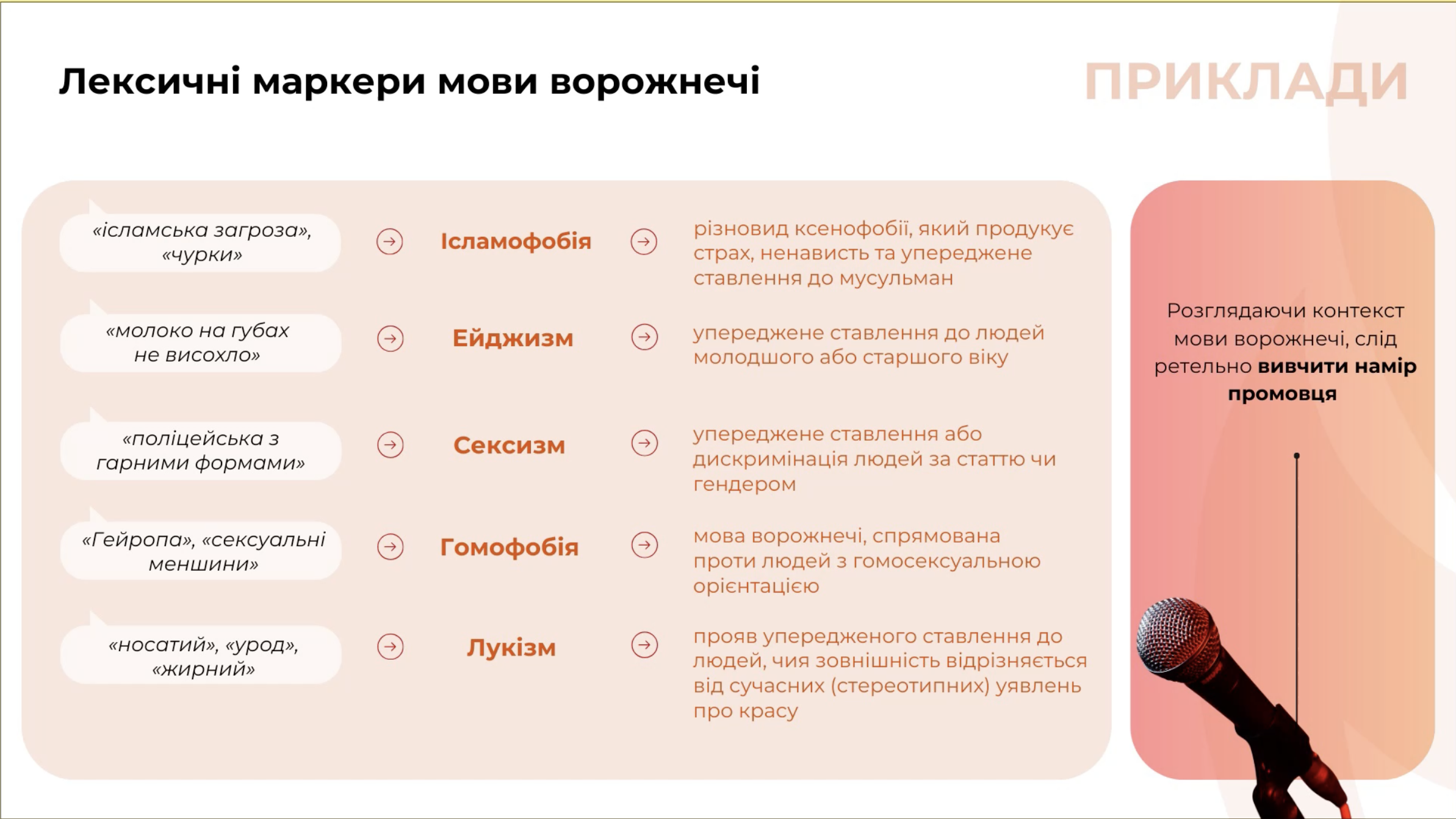
At the same time, the key criterion for identifying hate speech is whether a statement is linked to protected characteristics.
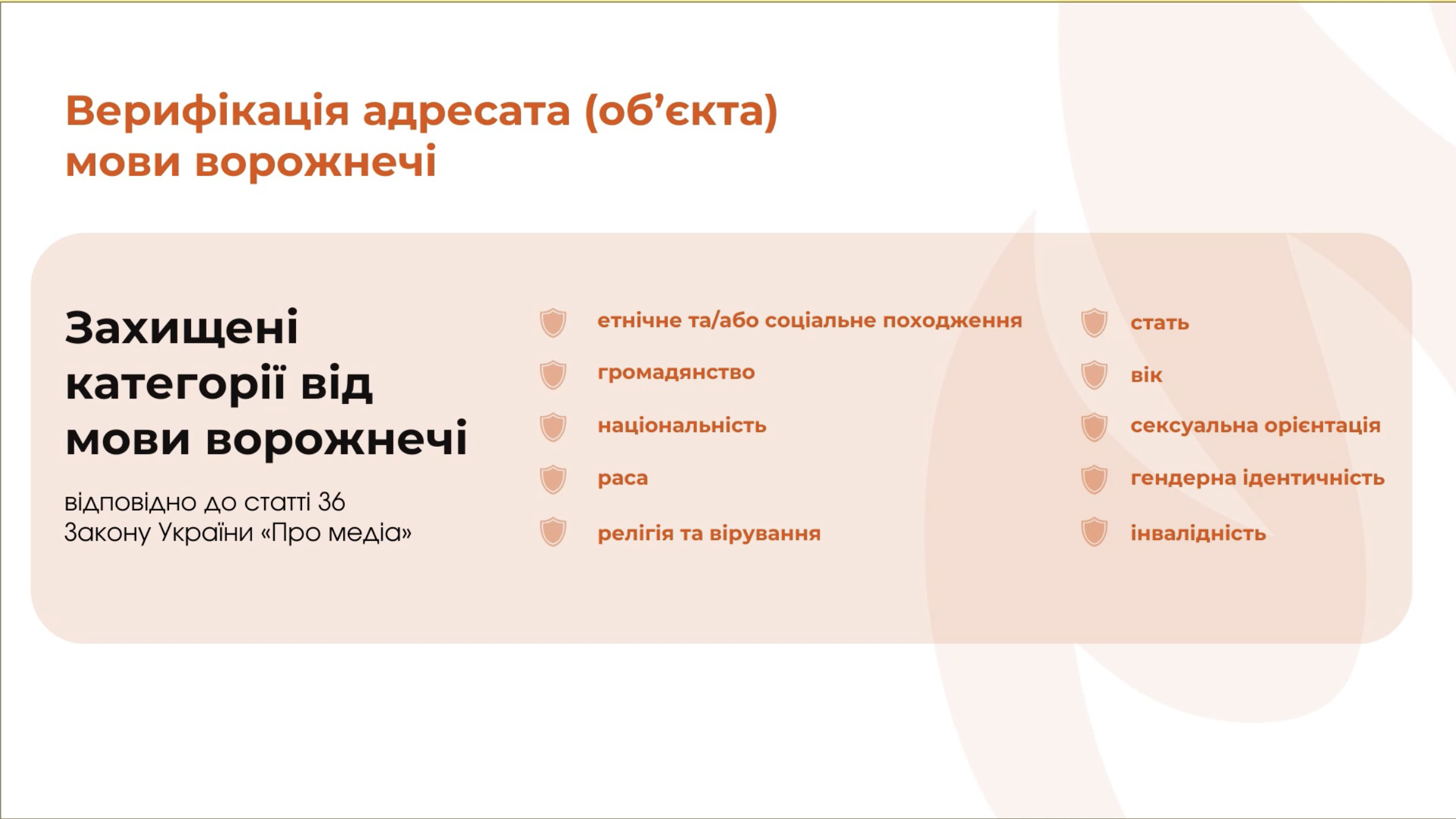
In its recommendations, the National Council on Television and Radio Broadcasting identifies the following protected categories:
- ethnic origin
- religion
- sex
- age
- disability
- sexual orientation
- gender identity
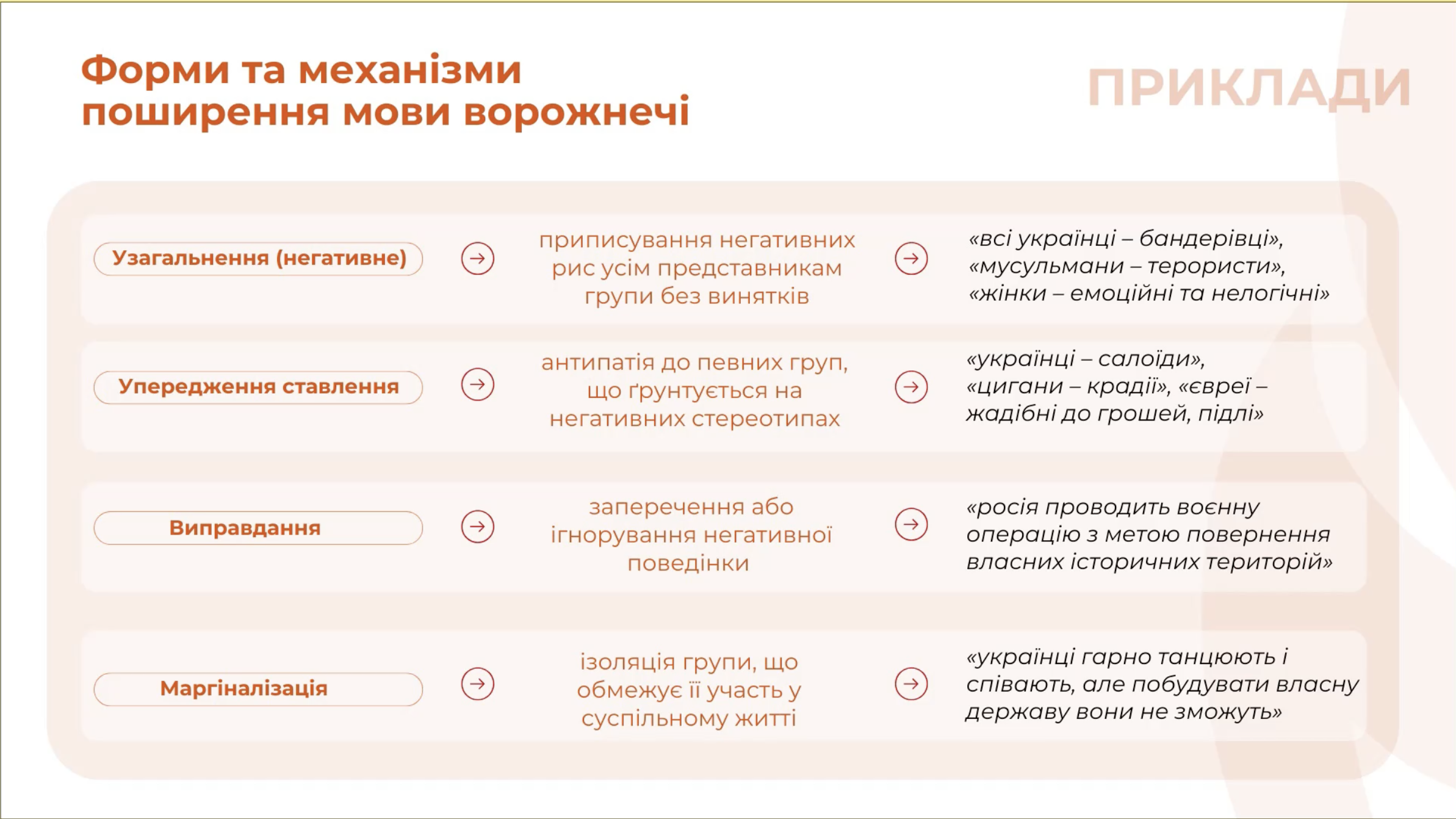
Among the forms and mechanisms of hate speech identified by the National Council in its presentation are:
- Dehumanization
- Demonization
- Satanization
- Negative generalization
- Identification/association
- Bias
- Justification
- Humiliation
- Discrimination
- Advocacy
- Glorification
- Incitement
- Defamation
- Trivialization
- Stigmatization
- Negative stereotyping
- Marginalization
- Radicalization
- Historical revisionism
- Mockery or ridicule
- Cultural erasure
- Particularly Severe Forms of Hate Speech
The National Council considers the following to be particularly severe forms of hate speech:
- Public incitement to commit genocide, crimes against humanity, or war crimes
- Racist, xenophobic, sexist, and LGBTIQ-phobic threats
- Public incitement to hatred, violence, or discrimination
- Racist, xenophobic, sexist, and LGBTIQ-phobic public insults
- Public denial, trivialization, or justification of genocide, crimes against humanity, or war crimes
- Intentional dissemination of materials containing manifestations of hatred, including ideas based on racial superiority or hatred
Why It Is Important to Gradually Overcome Hate Speech
The LGBTIQ Consortium of Ukraine welcomes these initiatives of the National Council on Television and Radio Broadcasting and expects legislative implementation of hate speech and hate crime provisions covering all vulnerable groups, including LGBTIQ+ people.
The LGBTIQ Consortium of Ukraine believes that the published recommendations are an important step toward creating a more responsible and inclusive media environment.
As Ukraine continues harmonizing its legislation with EU standards, it is important to ensure a clear definition of hate speech criteria and discrimination indicators in accordance with European norms. In particular, national legislation must fully take into account all protected characteristics, including sexual orientation and gender identity.
For Ukraine, implementing such approaches is important both for the development of society and its cohesion during wartime, as well as in the broader context of European integration.
News