LGBTIQ+ Rights Protection Becomes a National Policy Priority as Zelenskyy Signs Decree
15.10.2026


Protecting LGBTIQ+ rights is now among Ukraine’s national policy priorities. The government must develop an action plan for 2027–2029 outlining concrete measures to prevent discrimination, combat hate speech and hate crimes, and protect the rights of LGBTIQ+ people.
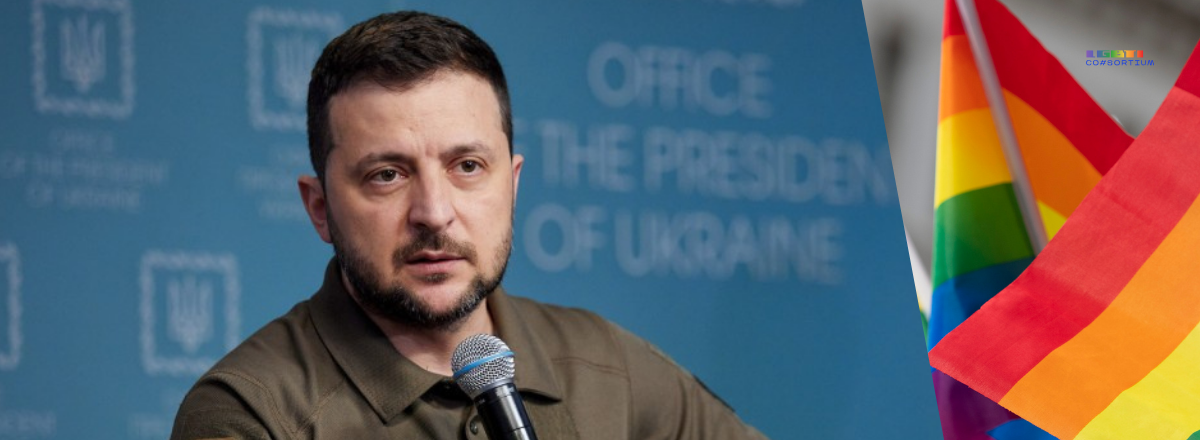
President Volodymyr Zelenskyy signed the corresponding Decree No. 1038/2026 on October 12, 2026.
The decree approves a new National Human Rights Strategy. Within six months, the government must develop and approve an action plan for implementing the Strategy in 2027–2029, involving representatives of government agencies, local authorities, civil society, and human rights experts. Subsequent action plans will be approved every three years, and the Cabinet of Ministers will report annually to the President on their implementation.
Protecting LGBTIQ+ Rights Becomes a Separate Operational Objective
For the first time, the new National Human Rights Strategy uses the full abbreviation LGBTIQ+, explicitly identifying the community among groups that may face a heightened risk of human rights violations or additional barriers to exercising their rights.
In the introductory section, LGBTIQ+ people are mentioned alongside other groups whose rights require particular attention from the state, including people with disabilities, veterans, internally displaced persons, members of national minorities, and Indigenous peoples of Ukraine.
However, the protection of LGBTIQ+ rights goes beyond a general reference. It is addressed in a separate Operational Objective No. 14:
“Preventing and combating discrimination, hate speech and criminal offences motivated by intolerance, and ensuring respect for LGBTIQ+ rights.”
Under this objective, the state acknowledges that LGBTIQ+ people remain among the groups at increased risk of discrimination, hate speech, and other forms of intolerance. The Strategy also highlights a lack of trust in state protection mechanisms, fears of stigmatization, and situations in which victims do not seek help even when legal grounds for protection exist.
Importantly, the document explicitly identifies all four characteristics relevant to protecting LGBTIQ+ rights:
“Sexual orientation, gender identity, gender expression and sex characteristics require clearer and more consistent recognition in legislation, particularly in provisions governing liability for criminal offences motivated by intolerance and in mechanisms for protection against discrimination.”
This approach is consistent with the European Commission’s terminology. These characteristics are also reflected in the EU LGBTIQ+ Equality Strategy for 2026–2030, adopted in October 2025.
The Strategy also identifies challenges extending beyond criminal law. These include the need to improve LGBTIQ+ people’s access to social protection, administrative, healthcare, educational, and other services, as well as legal assistance.
Particular attention is also given to strengthening the capacity of the Ukrainian Parliament Commissioner for Human Rights as the national equality body.
What Actions Must the State Take?
Operational Objective No. 14 calls for changes to legislation, law enforcement practices, judicial procedures, and support systems for victims of discrimination and hate crimes.
Key tasks include improving legal provisions on liability for discrimination, hate speech, and criminal offences motivated by intolerance; establishing an effective system for collecting statistical data; and ensuring victims have access to justice and free legal aid.
The Strategy also provides for training law enforcement officers and judges to investigate and adjudicate hate crimes in accordance with international standards and the needs of victims.
Some of this work is already underway. In particular, Draft Law No. 13597, registered in August 2025, is currently under consideration in the Verkhovna Rada. As of October 2026, the draft is being reviewed by a parliamentary committee.
Another priority is coordinating efforts to combat hate speech. In September 2026, with the support of the Council of Europe, Ukraine began establishing a national multi-stakeholder platform intended to bring together government institutions, civil society organizations, media representatives, and experts to monitor, prevent, and respond to hate speech.
What About Legal Recognition of Same-Sex Partnerships?
Although the new National Human Rights Strategy explicitly identifies the protection of LGBTIQ+ rights as a national policy priority, it does not include a separate objective concerning the legal recognition of same-sex partnerships. Nor does it directly mention the European Court of Human Rights judgment in Maymulakhin and Markiv v. Ukraine.
Nevertheless, this issue is already part of Ukraine’s international obligations. In its judgment of June 1, 2023, the European Court of Human Rights (ECtHR) found that the absence of any legal mechanism for recognizing and protecting a same-sex couple’s relationship constituted discrimination based on sexual orientation, violating Article 14 of the European Convention on Human Rights in conjunction with Article 8.
The judgment requires Ukraine to establish a legal framework that provides same-sex couples with adequate recognition and protection of their relationships.
This obligation is also directly linked to Ukraine’s European integration. Implementation of the June 1, 2023 ECtHR judgment is explicitly included in interim accession benchmark 23.14 on equality and non-discrimination under Chapter 23, Judiciary and Fundamental Rights.
At the same time, the absence of an explicit reference to registered partnerships does not prevent further work on their legal recognition, emphasized Sviatoslav Sheremet, Policy and Legal Coordinator at the National LGBTI Consortium, in a comment to #LGBTI_PRO.
“The reason is quite straightforward: the EU requires Ukraine to introduce some form of recognition for same-sex partnerships, but the state itself has the discretion to decide what legal form this should take. And right now, as a country, we are at a crossroads,” he explains. “On the one hand, there is a theoretical possibility of introducing the concept of a ‘de facto family union.’ Another option is to regulate registered civil partnerships through a separate law. Finally, basic provisions governing the family rights of LGBTIQ+ people could be incorporated into the new Civil Code, which currently exists as Draft Law No. 15150.”
According to Sheremet, there is another possibility: when Ukraine adopts a new Constitution or amends the existing one after martial law ends, it could simply extend marriage rights to everyone regardless of sex. This is precisely what the Constitutional Commission, which previously worked on the issue, had already recommended to the President.
News